


How to Read Coffee Flavor Notes (Without Overthinking)
The bag says "blueberry and jasmine." You taste coffee. This is a common experience, not a failure of your palate. Flavor notes are a shorthand vocabulary, not an ingredient list — and once you understand the five families that cover most Indian coffees, they become useful rather than confusing.

You buy a specialty coffee bag. The label says: blueberry, brown sugar, jasmine. You brew it carefully, pour a cup, take a sip, and taste coffee. Not blueberry. Not flowers. Coffee.
This happens in every specialty coffee market, and particularly so in India, where most buyers are encountering these descriptions for the first time. The confusion isn't a palate problem. It's a vocabulary problem.
Flavor notes are shorthand. They point toward families of aromatic experience a coffee shares with other known things, not toward added ingredients. They're not a promise of what you'll taste in every cup. Once that's clear, the label becomes a useful tool rather than a confusing promise.
This article covers: what flavor notes actually are, the five families that account for most of what appears on Indian coffee bags, how roast level predicts which family you're likely to encounter, and the Indian-specific vocabulary that doesn't appear on any global chart but shows up regularly on Indian roaster packaging.
What flavor notes actually are
Coffee is a fruit seed. A coffee cherry grows, ripens, gets picked, and undergoes processing (drying, fermenting, washing) before it's roasted. Through all of these stages, the bean develops hundreds of volatile aromatic compounds. Many of those same compounds are present in other fruits, nuts, flowers, and spices.
When a roaster describes a coffee as tasting of "blueberry," they're recognizing a shared compound, not reporting that blueberries were added to the roasting drum. The coffee contains organic acids and aromatic molecules that the human palate associates with blueberry. Wine works the same way when it describes "blackcurrant" or "pencil shavings" — neither is in the glass.
This vocabulary comes from cupping sessions: the coffee brewed in controlled conditions, evaluated at room temperature, tasted by multiple tasters at once. What they collectively identify becomes the language on the bag.
ICB's catalog documents hundreds of unique flavor note entries across more than 1,300 coffees, a range that reflects how many aromatic paths a single crop can take depending on where it grew, how it was processed, and how it was roasted. That breadth — close to one distinct note entry per coffee — suggests Indian roasters are actively differentiating their descriptions rather than defaulting to shared industry shorthand.
Flavor notes describe what a coffee's aroma and taste share with other known things. They are not claims about added ingredients, and they are not a promise of exact tasting outcomes. They are directional pointers toward a family of experience.
A practical way to read any note
Before navigating the families below, it helps to read any flavor note at three levels of resolution. Most buying decisions only need the first.
The broad stroke. Ask one question: is this coffee leaning bright and fruity, or deep and chocolatey? That single axis — acidity-driven brightness versus body-driven depth — predicts enjoyment more reliably than any individual descriptor.
The family. Narrow to one of the five families below — chocolate, caramel/sweet, fruity, nutty, or floral/earthy. This is usually enough to know what a cup will broadly deliver.
The specific descriptor. This is the "apricot versus blood orange" level — the precise analogy. It is the most fun to chase and the least important for buying. Tasting "something fruity and tangy" where the bag says "blood orange" means you have read the note correctly; you do not need to name the exact fruit.
The five flavor families in Indian coffee
Hundreds of unique notes sounds like an impossible amount to navigate. It isn't, because most of them cluster into five families. Understanding those five families gives a working map of what to expect from most Indian specialty coffees.
Across ICB's catalog of more than 1,300 coffees, the distribution breaks down as follows:
1. Chocolate/Cocoa
The most common family in Indian specialty coffee. Dark Chocolate is the single most frequent note (around one in ten coffees), followed by Chocolate, Milk Chocolate, and Cocoa. Combined, notes from this family appear on roughly 30% of all cataloged coffees. In the cup this family is smooth, rounded, and familiar — a natural extension of the roasted character most Indian coffee drinkers already associate with coffee.
2. Caramel/Sweet
The second most common. Caramel leads, followed by Honey, Vanilla, Brown Sugar, and Toffee, with the family appearing on roughly 25% of ICB coffees overall. In the cup: warm, mellow, sweet. Less intense than chocolate, less forward than fruit. Often appears alongside chocolate notes in medium-roast washed coffees.
3. Fruity
The broadest family in terms of variety, though individual notes appear at lower frequencies than chocolate or caramel. Citrus leads, followed by Raisin, Plum, Berries, Stone Fruit, Pomegranate, Strawberry, Mango, and many others. Taken together, fruity notes spread across roughly 35% of ICB coffees, often appearing several at a time. In the cup: bright, often with noticeable acidity, ranging from dried fruit sweetness to fresh tropical character. This is the family most likely to feel unfamiliar to buyers coming from a dark-roast background.
4. Nutty
Nutty, Roasted Nuts, Hazelnut, and Almond — about 15% of coffees. In the cup this family is dry, toasty, mild. It often accompanies chocolate or caramel notes and contributes texture more than distinctive flavor. Common in medium and medium-dark washed coffees.
5. Floral/Earthy
Less frequent but distinct: Floral, Jasmine, Earthy, and Spice. Floral notes appear mostly in light roasts, where origin-driven aromatics come through more clearly. Earthy notes trend toward medium-dark roasts and monsooned coffees, which carry a characteristic low-acid, dense-body profile.
That concentration in the chocolate and caramel families — combined, roughly 55% of the catalog — reflects where most of Indian specialty sits in terms of roast: predominantly medium to medium-dark. Roasters are largely producing profiles that extend from the dark-roast baseline most Indian buyers already recognize rather than departing from it.
This medium washed Chikmagalur coffee illustrates the chocolate/caramel family. Three of its four notes (Milk Chocolate, Peanut, Toffee) sit squarely in that cluster. Blackcurrant is a fruity note that often surfaces alongside chocolate in this roast range — a common overlap between the two families.

Many coffees carry notes from more than one family. A coffee described as "dark chocolate, raisin, and citrus" sits at the intersection of chocolate and fruity — both are accurate. The families overlap in real coffees, and that overlap is normal, not contradictory.
Browse more examples of this profile:
Medium Washed Coffees
The most common profile category in the ICB catalog — typically shows chocolate and caramel families.



How roast level predicts which family you're in
Roast level is the most reliable predictor of which flavor family will dominate a coffee. Across ICB's catalog, the pattern holds consistently enough to use as a navigation tool when reading a bag.
Light roast
Fruity and floral notes dominate: Floral, Citrus, Pineapple, Jasmine, Plum, Pomegranate, Mango, Strawberry. At this roast level, the bean retains more of its origin character, and the aromatic compounds that read as fruit or flowers come through clearly.
Light-medium
A transitional range where fruit and sweet notes coexist. Caramel, Citrus, Chocolate, Floral, Raisin, and Jaggery all appear with frequency. For buyers moving away from dark roasts, this range tends to be the most approachable entry into specialty coffee's broader flavor range.
Medium
The chocolate family takes over. Caramel, Dark Chocolate, Milk Chocolate, Nutty, Cocoa, and Honey are the dominant notes. Roast development at this level produces the Maillard-reaction compounds that read as chocolate and caramel. Fruit notes mostly recede.
Medium-dark
Similar to medium, with deeper character. Dark Chocolate, Caramel, Nutty, and Cocoa dominate. Fruit notes are largely absent.
Dark
Roast character dominates. Dark Chocolate, Cocoa, Caramel, Bitter, Oaky, and Burnt Caramel appear most often. This is the profile range most familiar to traditional South Indian filter coffee drinkers.
The middle of the roast range — light-medium and medium — makes up the largest part of the catalog. That concentration suggests roasters treat this range as a deliberate access point: familiar enough in character to not alienate buyers coming from darker roasts, differentiated enough in note range to register as something new.
One practical rule: when a bag lists fruity or floral notes, check the roast level. A light or light-medium roast supports those aromatics naturally. The same fruity note on a dark-roast bag warrants more skepticism — the roast profile tends to work against those compounds. For more on how roast decisions work in the Indian specialty context, see how roast levels work in Indian specialty coffee.
This light natural from Chikmagalur shows all three notes in the fruity family: dried fruit (Yellow Raisin), stone fruit (Mirabelle Plum), and fresh berry (Strawberry). Light roast combined with natural processing creates the conditions for this cluster.

Light Roast Naturals
Where the fruity family is most reliably present.
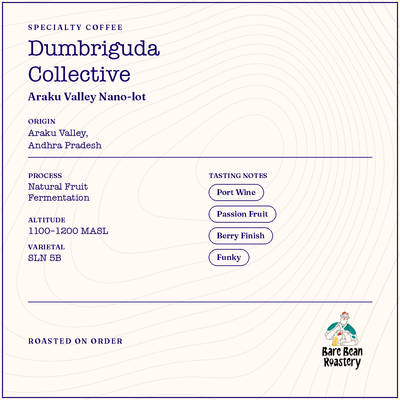


Indian notes on Indian bags
The Specialty Coffee Association's flavor wheel, the global industry reference for this vocabulary, was built primarily from Western taste references. Blueberry, peach, apricot, and elderflower are on it. Jaggery, tamarind, kokum, and sweet lime are not.
Indian roasters have been filling that gap on their own packaging, and the ICB catalog documents this vocabulary across the full range of coffees in the database:
| Note | What it means in the cup |
|---|---|
| Jaggery | Between caramel and molasses; earthy, unrefined sweetness |
| Pomegranate | Tart-fruity, slightly drying |
| Mango | Tropical sweetness, Alphonso-adjacent |
| Sweet Lime | Mosambi; rounder and less sharp than lemon |
| Tamarind | Sour-sweet depth; appears in Karnataka naturals |
| Jackfruit | Tropical, syrupy, slightly fermented sweetness |
These notes describe real compound profiles, and they describe them more precisely for an Indian palate than Western equivalents would. Jaggery captures something that "brown sugar" or "molasses" misses: the earthier, less refined quality of unprocessed cane sugar. Sweet lime (mosambi) is a more accurate descriptor than "citrus" for a certain quality of acidity — rounder, softer, less aggressive. Tamarind anchors a sour-sweet depth in certain naturals that has no clean Western parallel.
These aren't marketing inventions. They appear on Indian roaster bags because the roasters understand that their customers have different flavor reference points than the audiences the SCA wheel was designed for. The same logic extends informally to other pantry staples — warm spice reading as dalchini rather than cinnamon, dense dried-fruit sweetness as anjeer, toasty nuttiness as roasted badam. The reference frame that matches your own kitchen will always name a note faster than a translated one.
Smell before you sip. Aroma accounts for roughly 80% of perceived flavor, so the Indian pantry — the spice box, toasted dal, cardamom, jaggery melting in a pan — is one of the richest reference libraries available for naming what you find. If a bag says "caramel" but the aroma reads as jaggery to you, jaggery is the more accurate note for your palate.
The SCA flavor wheel hasn't been updated to include any of these terms. Their steady presence across the Indian market — jaggery, pomegranate, sweet lime, and the rest — is documented in ICB's catalog but absent from any global reference.
All three notes on this medium washed Chikmagalur coffee use Indian reference points. Chocolate sits in the familiar chocolate family; Jaggery places the sweetness more precisely than caramel would for most Indian readers; Peanut Chikki describes the nutty-sweet combination that this roast profile carries.

Using notes as a buying signal (not a test)
Flavor notes are developed in a controlled cupping environment. The coffee sits at room temperature, is sampled with a spoon, and is evaluated by multiple trained tasters working through a systematic process. What they collectively identify across that session becomes the vocabulary on the bag.
A home brewer making a pourover or French press is working in a different context entirely. The extraction is focused, the temperature is higher, and the process surfaces one or two dominant notes rather than the full range a room-temperature cupping might reveal. A bag that lists five notes often produces a cup where two or three of them are clearly present. Identifying the broad family — chocolatey, fruity, sweet — while missing a specific note like hazelnut or blackcurrant isn't a failure. It's how home brewing typically works.
Notes are most useful as a buying filter:
- For a smooth, sweet, familiar cup: chocolate or caramel family notes, medium roast, washed or honey process.
- For a brighter cup with fruit character: fruity family notes, light or light-medium roast, natural or honey process. See also: how processing method affects flavor.
- When you see Indian-vocabulary notes (jaggery, mango, raisin, tamarind), treat them like any other note — a directional signal toward a flavor family, translated into a reference frame that maps to your palate.
One reliable shortcut: track roasters, not just coffees. When you find a roaster whose "chocolatey" consistently matches yours, you have found a calibrated translator — more dependable than chasing individual descriptors across unfamiliar sources, and that calibration compounds with every purchase.
The palate calibrates over time. The more coffees you try within the same note cluster, the more reliably you'll recognize those compounds in the cup. The goal isn't to taste every specific note on the bag — it's to develop a working sense of what each family delivers.
Not tasting the specific notes listed on a bag is normal. Roasters cup in controlled conditions and report what they find across multiple tasters at room temperature. Home brewing produces a focused extraction that surfaces one or two dominant notes. If a coffee reads as sweet and chocolatey, and the bag listed dark chocolate and toffee, that's a successful calibration — even if the hazelnut they mentioned didn't register.
References
- SCA Coffee Taster's Flavor Wheel — Specialty Coffee Association, industry standard vocabulary framework for coffee flavor description
Related Coffees
- Medium washed coffees — the most common profile category in the ICB catalog; typically shows chocolate and caramel families
- Light-roast natural process coffees — where the fruity family is most reliably present
- Coffees with jaggery notes — examples of Indian-vocabulary notes across roast levels and processes
Coffee spotlights: 3 (Ratnagiri Washed AAA / Caarabi; Ratnagiri Estate Naturals / Corridor Seven; Thogarihunkal Washed / Tulum)
Schema blocks used: callout (×3), coffeeSpotlight (×3), coffeeCollection (×2)